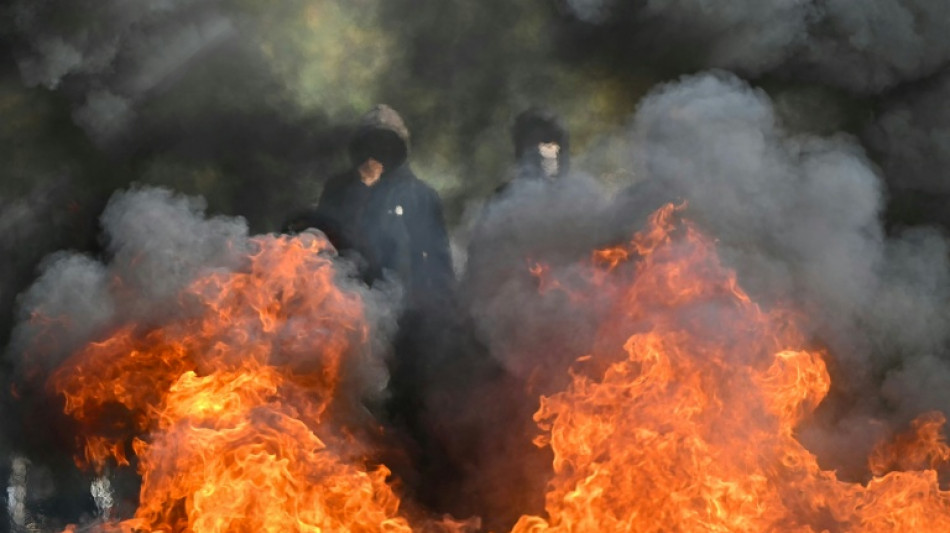
French school protests spread as fires, blockades deepen unrest / Photo: LOU BENOIST - AFP
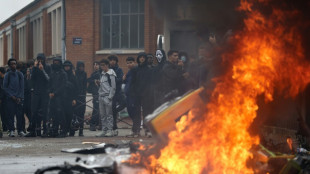
A protest by French secondary school students over overcrowded classrooms, teacher shortages and crumbling facilities deepened Thursday, with fires set outside schools and blockades in several cities.
More than 160 schools were shut down on Thursday, while university students joined the protests in Paris and Marseille. The movement in the lycees, which students aged 15 to 18 attend for their final three years of secondary education in France, has seen hundreds detained.
The government said the demonstrations had become "urban violence", and Prime Minister Sebastien Lecornu on Thursday urged all ministers to postpone any travel nationwide, according to a source close to the minister.
Since last week, pupils have staged protests outside schools over grievances ranging from timetables, class sizes and a shortage of teachers to overheated classrooms during this year's heatwaves.
The protests have spread across the country from the Paris suburbs, and the government has accused hard-left politicians of encouraging the unrest.
Riot police have been deployed to confront the students, and the force has launched internal probes after accusations of brutality against three pupils, according to Interior Minister Laurent Nunez.
Some 340 demonstrations were underway in front of high schools mid-morning, with more than 160 establishments shut down as a result, police said.
University students joined in on Thursday, blocking access to around 30 campuses, including in Paris and the southern city of Marseille, a student union said.
In the northern city of Caen, 16-year-old Maelle said she wished those setting fire to dustbins would instead protest "with words".
"We're demonstrating against overcrowded classes, against this government that spends millions on anti-phone pouches but doesn't invest in heating, air conditioning, or our teachers' salaries," she said, after the government at the start of the school year banned smartphones in schools.
- 'Zero budget' -
In the northwestern city of Nantes, firefighters had to intervene to put out a fire in the entrance of a high school "following a gathering marked by violence towards staff", the regional education board said.
Authorities reported violence near high schools, mainly in Nantes, blaming "violent individuals" who "join the students to carry out acts of vandalism".
In the northeastern city of Strasbourg, trams were ordered to grind to a halt to "restrict the movements of rioters and demonstrators", the regional prefect said.
Raphael, a 17-year-old who did not give his surname for fear of reprisals, was among the protesters outside a school in Strasbourg, where some used barriers to obstruct the nearby tramway tracks.
"There are 35 of us per classroom. With 35C in summer, it's unbearable. There aren't enough toilets, and there are water leaks in some rooms," Raphael said.
"The building is falling apart, the cafeteria is too small. There's zero budget, zero resources, not enough supervisors," he said.
Nearby, students took photos of themselves in front of burning rubbish bins, holding up the sign with their school's name ripped off the tram stop.
Most pupils did not take part in any vandalism, instead breaking out into a sprint down an avenue when the police fired tear gas.
In the southern city of Toulouse, hundreds of young people flooded the tram tracks, some toppling trash cans and starting fires, hurling projectiles or smashing bus shelters, AFP journalists said.
- 'Non-violent' -
In the northern city of Lille, AFP reporters saw young people wearing black hoodies destroy the glass of a bus stop. Firefighters intervened to put out the flames on upturned dustbins set on fire.
The government has accused the hard-left France Unbowed (LFI) party of encouraging the protests.
But LFI's candidate for the 2027 presidential election, Jean-Luc Melenchon, said on Wednesday that his party "called for non-violent methods of struggle".
Bally Bagayoko, the LFI mayor of the French capital's largest suburb Saint-Denis, said it was his responsibility to check in on students.
"It is the place of an elected official," he said, defending himself when questioned about going to see protesters outside a high school in Saint-Denis this week.
In neighbouring Belgium, there were protests and damage at a handful of schools in the eastern city of Liege, police said.
burs-ah/as/db-jj
C.Maes--LCdB