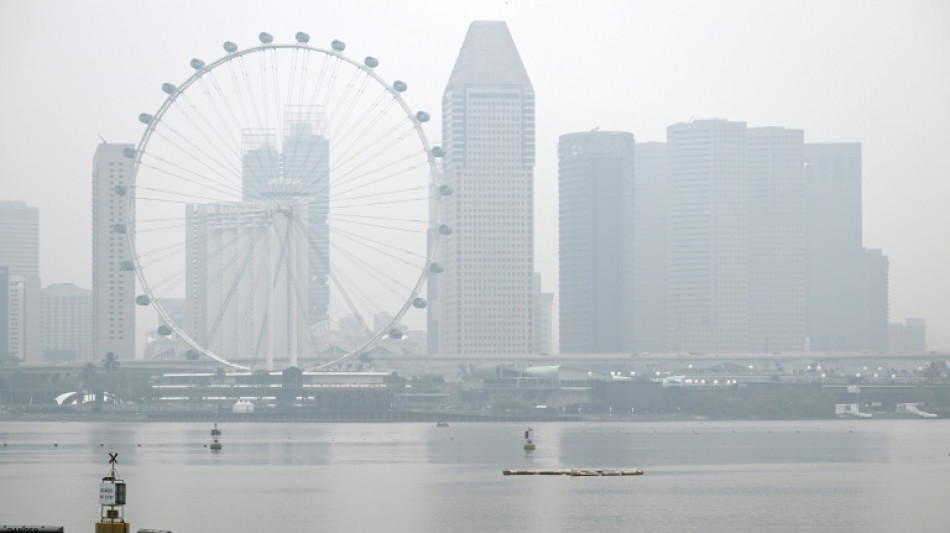
Haze pushes Kuala Lumpur, Singapore into world's most polluted cities / Photo: Roslan RAHMAN - AFP/File
Malaysia's capital topped a global pollution ranking on Wednesday and nearby Singapore came in third, with smoke from wildfires in neighbouring Indonesia blamed for the unhealthy conditions.
A milky haze has shrouded the cities for more than a month as smoke drifted from fires on Borneo and Sumatra islands.
Kuala Lumpur was the world's most polluted major city early on Wednesday, according to Swiss monitor IQAir, with an Air Quality Index (AQI) reading of 166. Singapore ranked third at 155.
The AQI converts measurements of pollutants into a single figure indicating air quality and potential health risks. Readings above 150 are classified as unhealthy, while levels above 300 are considered hazardous.
"It's really impacting our health and also the visibility," said Izzah Irdina, 22, a recent graduate from Kuala Lumpur.
"During this haze I can't even see the Merdeka 118," she said, referring to the world's second-tallest building.
"In another two months I hope the haze will end," added Izzah, who said she mostly stayed indoors.
Anusuriyeh, 41, told AFP she was "not sure when it's going to end because it's a natural disaster".
"But I'm taking daily vitamins to keep my vitality, and my children too are wearing a mask and taking vitamins," said the employee of Malaysia's petroleum giant Petronas.
Transboundary haze is a recurring problem in Southeast Asia, but this year's episode has been particularly severe.
Hot, dry conditions associated with the El Nino weather phenomenon have fuelled the fires in Indonesia, which are also linked to land clearing, making the blazes harder to contain.
- 'Pray for rain' -
In Singapore, 18-year-old student Darius Chew, who suffers from allergic rhinitis, said the haze had forced him to reduce his sporting activities.
"I've cut down on sports because it's really hard to continue as soon as I start sneezing," Chew told AFP.
Fellow student Ryan Ang, 18, who has asthma, said he had been sneezing more frequently and suffering from a runny nose, particularly in the mornings and at night.
"I'm not really cutting down on outdoor activities much, but it's affecting my health a bit," Ang said.
"You can't really do as much as you want to do," he added.
Retired Singaporean Athirah Abudullah, 69, said the haze has had less impact on her because she spends most of her time indoors.
She ventured out mainly for groceries and prayers at the mosque, but said her granddaughter, who suffered from eczema, had been affected by the haze.
"We have no choice, we just face it," Athirah said.
"We just pray for rain every day."
strs/jhe/ami
A.Louis--LCdB