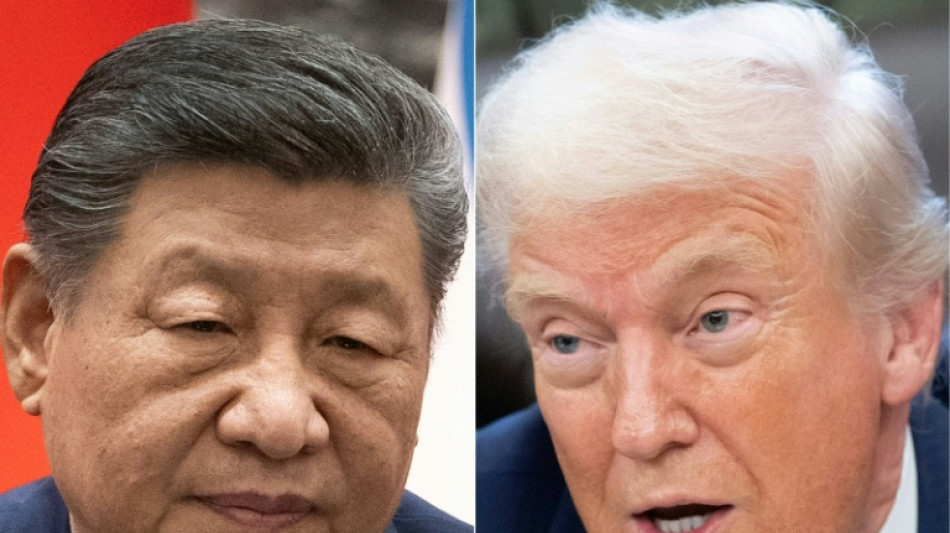
Xi calls for 'mutual respect' with Trump, hails ties with Putin / Photo: JESSICA LEE, SAUL LOEB - POOL/AFP/File
Chinese President Xi Jinping discussed Iran and other thorny subjects Wednesday with both US counterpart Donald Trump and Russia's Vladimir Putin, hailing tighter ties with Moscow and calling for "mutual respect" with Washington.
Trump and Putin both played up their nations' good relations with China after their respective calls with Xi, highlighting the Asian giant's centrality on the global stage.
But there were stark differences in the readouts of the two calls, with Xi warning Trump to proceed with "caution" on the touchy issue of Taiwan, shortly after he and Putin hailed the strengthening of bilateral ties in the face of a "turbulent" global situation.
Trump said his conversation with Xi was "excellent".
"The relationship with China, and my personal relationship with President Xi, is an extremely good one, and we both realize how important it is to keep it that way," Trump posted on his Truth Social platform.
The Republican said he and Xi had discussed trade, Taiwan, Russia's war in Ukraine and Iran, as well as a planned trip to China, which he said "I very much look forward to".
Xi meanwhile voiced hope that bilateral issues, amongst which trade figures prominently, could be resolved amicably between the world's two biggest economies.
"By tackling issues one by one and continuously building mutual trust, we can forge a right way for the two countries to get along," Xi said, according to state broadcaster CCTV.
"Let us make 2026 a year in which China and the United States, as two major countries, move toward mutual respect, peaceful coexistence and win-win cooperation."
- Taiwan tension -
On Taiwan, however, Xi warned Washington to exercise caution in arms sales to the democratically run island, which Beijing claims.
"The Taiwan question is the most important issue in China-US relations... The US must handle arms sales to Taiwan with caution," Xi said, according to the state broadcaster.
China's Communist Party has never ruled democratic Taiwan, but Beijing claims the island of 23 million people is part of its territory and has not ruled out the use of force to annex it.
Washington does not officially recognise Taiwan, but is the island territory's main military backer -- although the tone of that support has softened slightly under Trump.
The United States approved $11 billion-worth of arms to Taiwan in December, Taipei said.
Shortly thereafter, China launched major live-fire drills to simulate a blockade around Taiwan's key ports.
- Putin's 'dear friend' -
Speaking by video call several hours earlier, Xi and Putin hailed the strengthening of Chinese-Russian ties.
The two countries have sought to present a united front against the West, with ties deepening since Moscow's 2022 invasion of Ukraine.
A Kremlin aide said the Xi-Putin call was "friendly and trusting" and lasted nearly an hour and a half.
Moscow has increasingly relied on China throughout the Ukraine conflict to keep its economy afloat, faced with crippling Western sanctions.
China has never denounced Russia's war or called for it to withdraw troops, and many of Ukraine's allies believe that Beijing has provided support to Moscow.
"Since the beginning of the year, the international situation has become increasingly turbulent," Xi told Putin, calling for "deeper" Chinese-Russian coordination, according to state TV.
Addressing Xi as his "dear friend", Putin voiced a similar message, in a video broadcast on Russian state TV.
The Kremlin said Putin had accepted invitations to visit China in the first half of 2026 and attend the APEC regional summit hosted by Xi in November.
The calls took place as Russian, Ukrainian and US negotiators met in Abu Dhabi for a new round of talks on ending the almost four-year war, which has turned into Europe's worst conflict since World War II.
Putin and Xi discussed their "opinions" on the United States, views that according to the Kremlin "practically matched" each other.
And "special attention was given to the tense situation in Iran", said Kremlin aide Yuri Ushakov.
The calls follow a series of meetings between Xi and various leaders in recent months, as he consolidates diplomatic support in the face of an increasingly unpredictable United States.
Beijing has sought to position itself as a stable alternative to Washington, hosting Western leaders including US allies recoiling from Trump's bid to seize Greenland and tariff threats.
burs-oc/jc/ami/jhb/sbk
E.Willems--LCdB