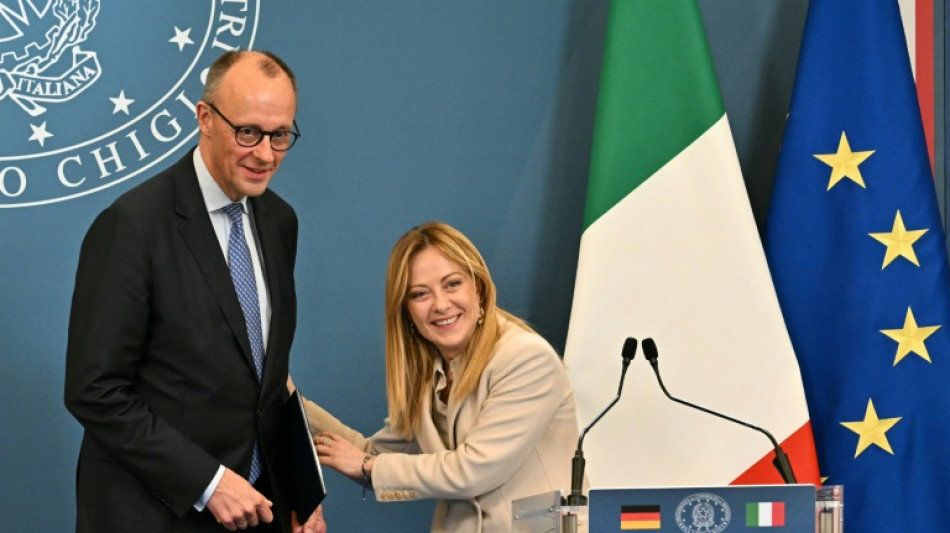
Meloni and Merz: EU's new power couple / Photo: Andreas SOLARO - AFP/File
From trade deals to cars, Italian Prime Minister Giorgia Meloni and German Chancellor Friedrich Merz are increasingly joining forces to steer the EU agenda -- risking sidelining French President Emmanuel Macron.
During an EU leaders summit on Thursday, far-right Meloni and conservative Merz will be pushing a shared vision for boosting EU competitiveness.
It is the latest sign of the growing cooperation between Rome and Berlin, which is putting a question mark on the traditional France-Germany axis.
"Some observers say that 2026 will be the year of Italy and Germany," Meloni said last month at a summit with Merz in Rome.
"We intend to give it our all... to consolidate a friendship that is strategic not only for our nations, but for Europe as a whole."
The two leaders have long shared a tough approach to migration, but agreed to expand their cooperation on everything from trade policy to defence at the Rome summit.
They have also been aligned on several issues in Brussels in recent months.
In January, despite her initial reluctance, Meloni finally backed the EU's trade agreement with South America's Mercosur bloc, to Germany's delight.
France, Berlin's traditional ally, unsuccessfully tried to block the deal over concerns for its farmers.
Both Berlin and Italy also helped pressure the EU to water down its 2035 ban on new petrol and diesel cars -- a decision again opposed, unsuccessfully, by France.
"What I'm hearing is that the Franco-German axis isn't working; Meloni and Merz are doing their own thing together," one European diplomat told AFP on condition of anonymity.
- Parallel convergence -
Like France, Italy and Germany are both founding members of the EU and allies in the NATO military alliance.
But Rome and Berlin have often been at odds, not least over matters of money -- frugal Germany versus debt-laden Italy.
Yet as Meloni has sought to bring down the deficit, and Merz has broken with tradition to ramp up borrowing and investment, this old dynamic has changed.
On foreign policy, too, they have both sought to keep US President Donald Trump onside.
"I'd describe it as a parallel convergence," said Matteo Villa of Italy's ISPI think tank.
"The die is cast, and the time is coming when these two are more compatible than the classic France-Germany pairing," he told AFP.
Italian Foreign Minister Antonio Tajani told Il Messaggero daily in an interview Wednesday that the Italy-Germany pairing was similar to the close ties when the EU was founded.
"A new season is beginning: Italy has a leading role, it wants to be one of the locomotives of the EU," he said.
He said Italy and Germany were the bloc's "two most industrialised and stable countries".
- 'Moving Europe forward' -
French President Emmanuel Macron, whose country has been mired in political crisis since snap polls in 2024, has rejected any suggestion of being sidelined.
In an interview with several European newspapers published Tuesday, he said it was "normal" that Rome and Berlin present their proposals to EU leaders in the wake of their summit.
"The Franco-German partnership is essential for moving Europe forward. But it is never enough on its own," he said.
He noted he and Meloni will hold their own Italy-France summit within a few weeks -- likely April in Toulouse, diplomatic sources say.
But Macron-Merz relations have been cooling.
Diplomats say France's attempts to block the Mercosur deal created bad blood in Brussels and among other member states, including Germany.
Meanwhile Germany is reportedly preparing to abandon the troubled Future Combat Aircraft System (FCAS), a fighter jet project with France and Spain stalled for months due to tensions between its corporate partners.
Berlin is instead eyeing up Italy's Global Combat Air Programme (GCAP) with Britain and Japan, media reports say.
"The gaps between Paris and Berlin mean Berlin is having to look to other partners," Thomas Maddock, a fellow at the Centre for European Reform in London, told AFP.
An opinion piece in Germany's Bild tabloid was more brutal.
"Merz knows that for Europe to have a voice internationally, he needs strong partners at his side," it wrote.
It added: "Unlike France, Italy is now a country with a stable government and a successful economy."
burs-ar/jxb
U.Laurent--LCdB