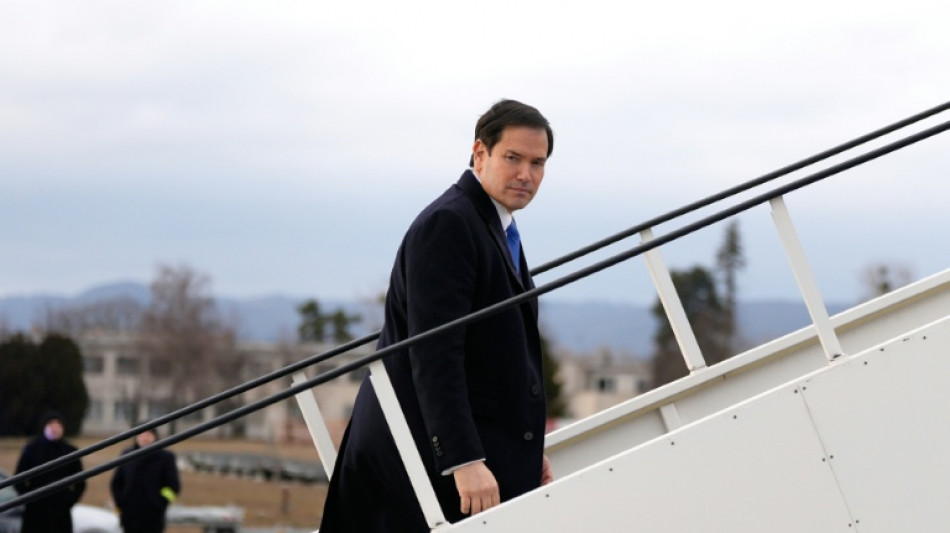
Rubio visits Trump's 'friend' Orban ahead of Hungary polls / Photo: Alex Brandon - POOL/AFP
US Secretary of State Marco Rubio has arrived in Hungary for talks with Prime Minister Viktor Orban Monday, ahead of elections where the nationalist leader faces a significant challenge from the opposition.
Rubio's visit is the final stage of a whirlwind trip to Europe that also saw him address the Munich Security Conference and visit another right-wing ally, Slovakian Prime Minister Robert Fico.
US President Donald Trump has made no secret of his high regard for Orban, saying in a social media post on Friday that the prime minister had produced "phenomenal" results in Hungary.
But Orban, 62, has a fight on his hands for the April 12 legislative elections in Hungary. Polls suggest his Fidesz party is trailing opposition leader Peter Magyar's TISZA.
In a speech on Saturday, Orban insisted he would keep up his fight against "pseudo-civil organisations, bought journalists, judges, politicians" -- a tirade not unlike those favoured by Trump.
He also took aim at the "oppressive machinery of Brussels", another jibe at the European Union's leadership, with whom he has long been at loggerheads on a host of issues.
Orban is in the firing line of the EU's leadership for what they say is his silencing of critical voices in the judiciary, academia, the media and civil society. They also accuse him of going after minorities.
Adding to tension with the EU is the close relationship he has maintained with Russia's President Vladimir Putin -- another thing he has in common with Trump.
- Conciliatory tone -
Rubio arrived in Budapest on Sunday evening, and was due to hold talks with Orban on Monday morning before flying back to Washington.
The decision to visit Fico and Orban, two nationalist leaders close to both Trump and Putin -- and out of step with the EU consensus -- sends a clear diplomatic message.
In his speech on Saturday to the Munich Security Conference, Rubio called on Europe to join Trump in his fight to defend Western civilisation from the threat of mass immigration.
But he tried, too, to reassure European leaders over the US position on NATO, and on Greenland -- with mixed success.
"We want to be your partner. We want to work with Europe. We want to work with our allies."
Orban is one of several leaders to have announced he will travel to Washington next week for the inaugural meeting of Trump's controversial "Board of Peace" -- which critics see as an instrument designed to undermine the UN Security Council.
Orban became a hero to many Trump supporters for his hostility to migration during the Syrian refugee crisis a decade ago. He has made several visits to Trump's Mar-a-Lago resort in Florida.
And energy will be on the agenda in Monday's talks, just as it was in Slovakia.
When Orban visited the White House in 2025, Trump granted Hungary an exemption from sanctions imposed on Russian oil and gas imports over Moscow's invasion of Ukraine.
Y.Bernard--LCdB