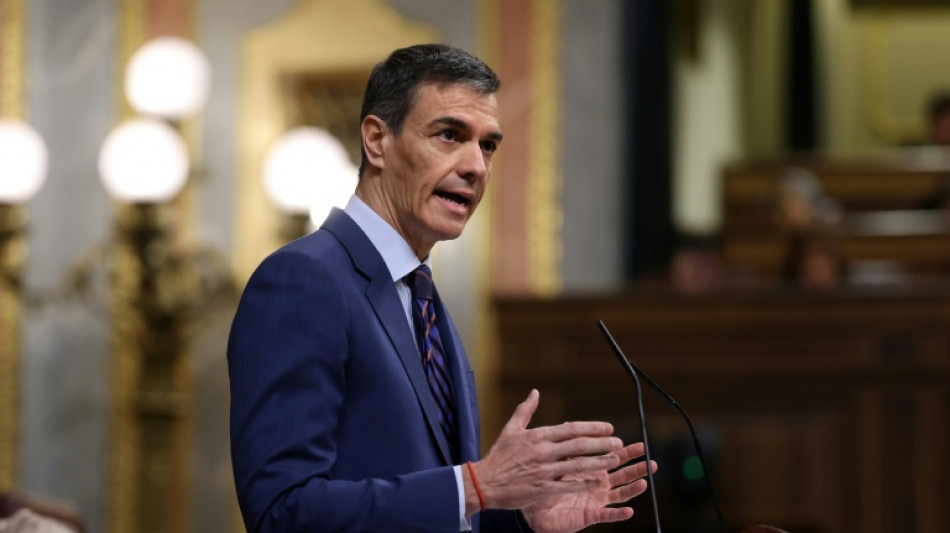
Spanish PM says Middle East war 'far worse' than Iraq in 2003 / Photo: Thomas COEX - AFP
Spanish Prime Minister Pedro Sanchez warned Wednesday that the Middle East war presented a "far worse" scenario than the invasion of Iraq in 2003.
"This is not the same scenario as the illegal war in Iraq. We are facing something far worse. Much worse. With a potential impact that is far broader and far deeper," he told parliament.
"This time, it's an absurd and illegal war. A cruel one that sets us back from achieving our economic, social, and environmental goals."
The Socialist premier has refused Washington's requests to use Madrid's military bases against Iran, despite US President Donald Trump's threat to sever trade with Spain as a result.
Sanchez said the US invasion of Iraq in 2003 had failed to achieve its goals and instead made life worse for ordinary people, saying it led to a sharp increase in fuel and grocery prices, a migration crisis and jihadist attacks in Europe.
He warned that the attacks on Iran could have a similar economic impact for millions.
"Every bomb that falls in the Middle East eventually hits -- as we are already seeing -- the wallets of our families," Sanchez said.
His government approved last week a sweeping package worth five billion euros ($5.8 billion) aimed at cushioning the economic impact of the Middle East war, which included reductions on taxes on fuel.
"It is not fair that some set the world on fire while others bear the ashes. It is not right that Spaniards and other Europeans should pay out of their own pockets for this illegal war," Sanchez said.
His Iraq reference may strike a chord with Spanish voters.
Support for that war by the conservative Popular Party (PP) in power at the time which sent troops to Iraq was widely unpopular and sparked mass protests.
Some analysts say it paved the way for the Socialist Party’s surprise win in March 2004, days after deadly jihadist bombings hit Madrid.
A branch of Al-Qaeda claimed responsibility for the attacks and called for the withdrawal of Spanish forces from Iraq.
T.Luyten--LCdB