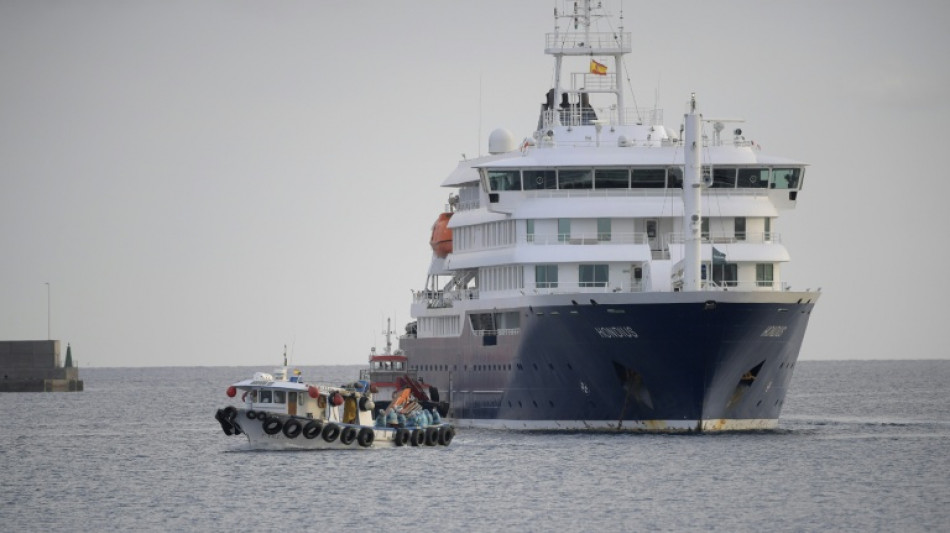
US, French evacuees from hantavirus ship test positive / Photo: JORGE GUERRERO - AFP
An American citizen and a French woman evacuated from the cruise ship hit by a deadly hantavirus outbreak have tested positive, officials said, as the repatriation operation continued on Monday.
Following the positive test results, Spain defended the rigour of its sanitary measures during the complex evacuation Sunday of 94 people of 19 different nationalities from the MV Hondius, which is moored in the Canary Islands.
The Dutch-flagged vessel has been at the centre of global concern after three passengers died following an outbreak of the rare virus, which usually spreads among rodents and for which no cure exists.
Health officials have insisted that the risk to global public health is rare and dismissed comparisons to the Covid-19 pandemic.
The French woman, one of five evacuees from France placed in isolation in Paris, started to feel unwell on Sunday night, and "tests came back positive", Health Minister Stephanie Rist said Monday.
Late Sunday, the US health department said one American national evacuated from the ship had "mild symptoms" and that another had tested positive for the Andes virus, the only hantavirus strain that is transmissible between humans.
Spain's health ministry said "all measures" had been taken to stop the virus spreading during the evacuations, in which medical teams escorted passengers from the ship to an airport on the island of Tenerife under close supervision and following health checks.
It said the French patient "started to feel unwell during the flight and not while she was on the ship".
The US citizen who tested positive "did not show symptoms when they were in Cape Verde", where the MV Hondius stopped before reaching the Canary Islands, the ministry said.
"However, the US authorities have decided to treat the case as positive. For that reason, they requested a separate evacuation, which was carried out in a separate boat."
- Final flights to leave -
In all, eight cases have been confirmed in the outbreak, and two more are listed as "probable", according to the World Health Organization and national health authorities, with citizens of six countries affected.
Other suspected cases and potential close contacts with infected people are being investigated, with health authorities in several countries tracking passengers who had already disembarked from the ship, plus anyone who may have come into contact with them.
Rist said 22 more close contacts had been identified among French nationals, including eight people who had travelled on an April 25 flight between Saint Helena and Johannesburg, and 14 more on a flight between Johannesburg and Amsterdam.
Two more repatriation flights to Australia and the Netherlands are planned on Monday to complete the evacuation of most of the ship's almost 150 passengers and crew.
After refuelling, the ship is scheduled to leave Tenerife for the Netherlands at 7:00 pm (1800 GMT) with a skeleton crew.
"There are still some citizens from the Netherlands and Australia, and hopefully we can even finish before the scheduled time," Spanish minister Angel Victor Torres told public radio RNE.
The MV Hondius left Argentina, where hantavirus is endemic, on April 1 for a cruise across the Atlantic Ocean to Cape Verde.
The World Health Organization believes the first infection occurred before the start of the voyage, followed by transmission between humans on board the vessel.
But Argentine health officials have questioned whether the outbreak originated in Ushuaia, based on the virus's weeks-long incubation period and other factors.
burs-al/imm/jhb
S.Denis--LCdB