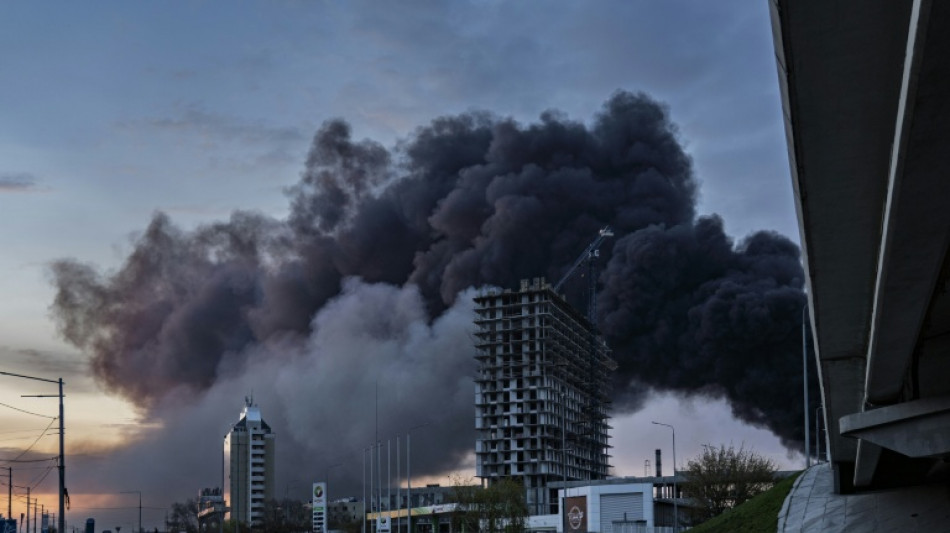
Russian strikes kill at least 19 across Ukraine / Photo: Serhii Okunev - AFP
A massive Russian drone and missile barrage killed at least 19 people in cities across Ukraine, more than four years into the war with talks on ending the conflict stalled.
AFP journalists heard loud bangs echoing over the capital during the night and saw huge plumes of black smoke rising over central Kyiv at dawn.
More than 100 people were wounded in the attacks that ripped through apartment buildings in the middle of the night.
"The impact happened immediately. I heard screams, and we ran quickly. I tried to jump out of the apartment to save myself," a woman called Tetiana in Odesa, the heaviest hit city, told AFP.
Her neighbour Roman, lost his son and daughter-in-law in the barrage.
"The ceilings collapsed, we were pinned by furniture. My wife and I tried to get out. She rushed to our son and screamed, 'half his head is gone'," he told AFP, his voice quivering and breaking into tears.
In Kyiv, 19-year-old Yeva said the roof collapsed on her mother and two-year-old brother when a Russian drone crashed into it, almost completely destroying the apartment block.
"They were saved by a miracle, because the attic collapsed right onto them," she told AFP.
Ukrainian President Zelensky, on a tour of Europe, called for a minute of silence for those killed, at an event in a church in the Netherlands.
"Today in Ukraine is another very hard day, a really hard night, the day after a massive Russian attack," he said.
The attack "has proven Russia does not deserve any easing of global policy or lifting of sanctions," he wrote on social media.
EU council chief Antonio Costa accused Russia of choosing to "deliberately terrorise civilians", decrying the overnight killing as a "horrendous attack against civilian targets".
Moscow has fired hundreds of drones on its neighbour almost nightly since the beginning of the war, with Kyiv regularly carrying out strikes on Russian energy and military targets in response.
Russia's invasion of Ukraine, launched in February 2022, has killed hundreds of thousands of people and displaced millions, in what has become the deadliest conflict in Europe since World War II.
- Peace talks in limbo -
The Ukrainian air force said Russia had launched 659 drones and 44 missiles in an attack that started Wednesday daytime and stretched until dawn on Thursday.
The Russian army said it had "carried out a massive strike" against Ukrainian military and energy targets.
Moscow has repeatedly denied targeting civilians throughout its invasion, despite thousands killed in strikes on apartments, hospitals, train stations and other civilian infrastructure across the country.
The Kremlin's latest deadly attack comes with US-led talks on how to end the conflict sidelined by the war in the Middle East.
Even before then, progress had been slow with no signs Russia was willing to compromise on its hardline territorial and political demands that Kyiv has rejected as tantamount to capitulation.
Kyiv has also stepped up its own long-range drone and missile attacks on Russia.
Strikes overnight killed two people, including a child in southern Russia, officials said.
A 14-year-old girl and a young woman were killed in the Black Sea city of Tuapse when a volley of drones hit housing and a music school, local governor Veniamin Kondratyev said. Five other people were wounded.
The Russian army said its forces intercepted 207 Ukrainian drones across its western and southern regions.
In the Ukrainian capital of Kyiv, four people were killed, including a 12-year-old boy, and at least 62 wounded, mayor Vitali Klitschko said.
Among those wounded were several medics responding to a first wave of strikes, he said.
AFP journalists at the scene of one strike saw a damaged ambulance and the body of one victim covered with a thermal blanket on the street.
Five more people were killed and another 33 were wounded in the central Dnipropetrovsk region, Oleksandr Ganzha, head of the regional administration said on Telegram.
burs-jbr-asy/jc/yad
H.Vermeulen--LCdB