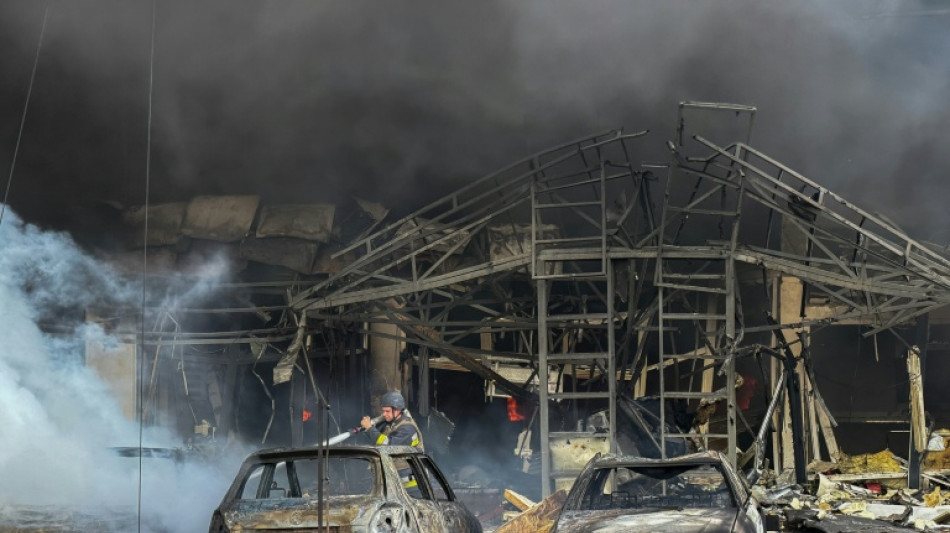
Ukraine reports strike as Kyiv's ceasefire due to begin / Photo: Darya NAZAROVA - AFP
The unilateral ceasefire announced by Kyiv was due to take effect on Wednesday, but Ukraine accused Russia of new strikes just hours after attacks killed at least 28 people in cities across the war-battered nation.
Russian authorities did not immediately report any Ukrainian strikes several hours into the proposed truce, while officials in Ukraine's southern Zaporizhzhia region said early Wednesday that Moscow fired on their infrastructure.
Moscow and Kyiv each announced unilateral ceasefires over different dates this week, with Russia demanding a pause to coincide with its annual World War II Victory Day commemorations on May 9.
Ukrainian President Volodymyr Zelensky accused Moscow of "utter cynicism" for launching deadly strikes while seeking a halt to hostilities.
Ukraine's Interior Minister Igor Klymenko said late Tuesday -- before Kyiv's halt was due to take effect -- that authorities were dealing with the aftermath of Russian strikes in regions including Poltava, Kharkiv, Donetsk, Dnipropetrovsk, Zaporizhzhia, Kherson, Odesa, Chernigiv and Sumy.
"As of now, 27 people have been killed and at least 120 injured as a result of today's Russian strikes across the country," Klymenko said.
A subsequent update from the eastern city of Kramatorsk added one more fatality.
Ukrainian drone strikes also killed five civilians, according to an early Wednesday update from the head of the Crimea region, which Russia annexed in 2014 from Ukraine.
Russia attacked the city of Dnipro late on Tuesday, nearing Kyiv's deadline.
"With mere hours until Ukraine's ceasefire proposal comes into force, Russia shows no signs of preparing to end hostilities. On the contrary, Moscow intensifies terror," Ukraine's Foreign Minister Andrii Sybiga said on X.
Zelensky earlier described an attack that killed 12 people in Zaporizhzhia -- Ukraine's southern city close to the front line -- as having "absolutely no military justification".
Russian strikes also hit the centre of Kramatorsk, the last hub under Kyiv's control in the embattled Donetsk region.
Six people were killed, according to an update by Kramatorsk city's military administration Oleksandr Goncharenko late Tuesday, revising initial reports of five dead.
Zelensky said that the attack on Kramatorsk "hit right in the city centre, targeting civilians".
Four civilians were killed in Dnipro, he said.
The attacks were the deadliest in weeks and peace efforts have gone quiet.
Yet, US Secretary of State Marco Rubio spoke by telephone on Tuesday with Russian Foreign Minister Sergei Lavrov, according to the State Department.
The two, who spoke at Lavrov's request, "discussed the US-Russia relationship, the Russia-Ukraine war, and Iran," State Department spokesman Tommy Pigott said, without giving details.
Russia confirmed the call and noted they discussed the "schedule of bilateral contacts", but did not elaborate.
- Intensifying strikes -
Russia's May 9 parade is typically a bombastic display of military strength, which since 2022 has sought to link Soviet victory over Nazi Germany with the invasion of Ukraine.
But the Kremlin ordered a scaled-back version this year -- with no military hardware to be on display -- over the fear it could be targeted by Ukraine.
Moscow also cut mobile internet throughout the Russian capital Tuesday morning ahead of the parade, with operators reporting restrictions would last until Saturday.
Kyiv has intensified its retaliatory long-range strikes in recent weeks, hitting a spate of Russian oil facilities and a luxury high-rise building in Moscow.
Short-term ceasefires are not infrequent, with the two sides having suspended long-range attacks over Orthodox Easter last month.
There is no sign that the four-year war is close to being resolved at the negotiating table.
Moscow has demanded that Kyiv fully withdraws troops from the eastern Donbas area and renounces Western military support -- ultimatums seen as tantamount to capitulation in Kyiv, which has rejected them.
burs-ach/hol/jm
N.Moens--LCdB