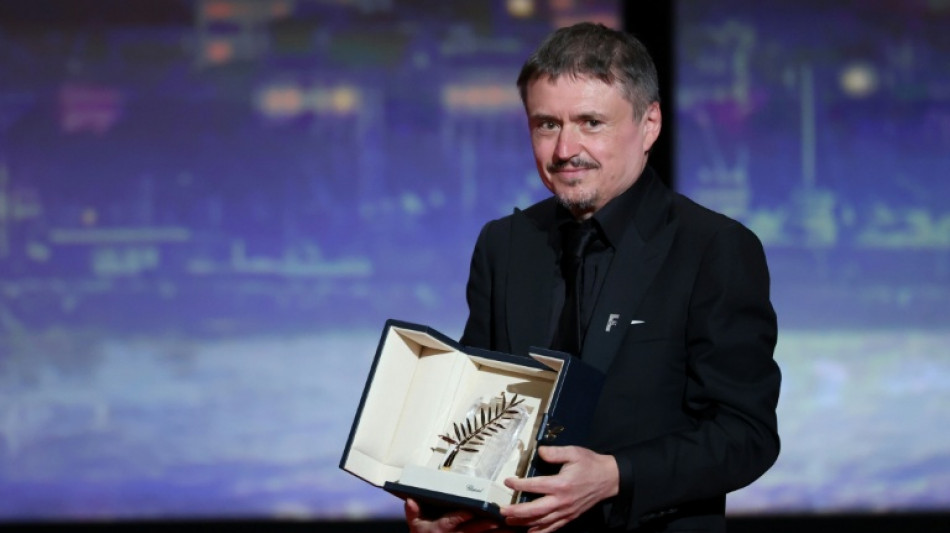
Romania's Mungiu wins top prize at glitzy Cannes finale / Photo: Sameer AL-DOUMY - AFP
"Fjord", a thought-provoking drama by Romanian director Cristian Mungiu that challenges left-wing prejudices, won the best film prize at the Cannes Film Festival on Saturday at a star-packed closing ceremony.
In his second Palme d'Or-winning film, Mungiu explores the contradictions of Scandinavia's supposed tolerance in a drama starring Renate Reinsve ("Sentimental Value") and Sebastian Stan ("The Apprentice").
It follows a devoutly Christian Norwegian-Romanian couple and their five children who move to a remote village in Norway and become the subjects of a child abuse investigation.
"This is a message about tolerance, inclusion and empathy. These are wonderful values that we all cherish, but we need to put them into practice more often," Mungiu told the audience.
The movie is based on true events and is notable for how it questions the progressive values of Norwegian society and appears sympathetic to the conservative religious characters -- a departure from most arthouse festival fare.
The 146-minute drama became one of the biggest talking points in Cannes, praised as a "brilliantly knotted social drama" by Variety and a "masterful drama of our polarized times" by Deadline.
Russian family drama "Minotaur" by Andrey Zvyagintsev, which depicts a callous businessman caught up in Russia's invasion of Ukraine, won the Grand Prix second prize.
Another Cannes regular, Zvyagintsev is an acclaimed filmmaker whose bleak portraits of modern Russia under Vladimir Putin have led to a string of awards and two Oscar nominations.
The 62-year-old, who now lives in exile in France, urged Putin to put an end to the "carnage" in Ukraine in his acceptance speech.
- Double winners -
Among the other prizes, Belgium's Virginie Efira and Japanese actor Tao Okamoto shared the best female performance award for their roles in touching nursing home drama "All of a Sudden" by Japan's Ryusuke Hamaguchi.
Belgian duo Emmanuel Macchia and Valentin Campagne from gay World War I romance drama "Coward" also shared the male best actor award for their roles in the Lukas Dhont-directed movie.
Rwandan filmmaker Marie-Clementine Dusabejambo won the Camera d'Or for best first film for her genocide drama "Ben'Imana" which she dedicated to "the women of my country".
Other critics' favourites in Cannes included arty black-and-white historical drama "Fatherland" and "La Bola Negra", a big-budget Spanish drama about multiple gay lives.
The movies both won best director, in a third shared award.
- Talking points -
Cannes is the world's biggest film festival, providing a crucial platform for independent cinema, as well as a showcase for fashion and celebrities to rival the Academy Awards or the Met Gala.
The 79th edition was packed with its usual stable of A-listers, from John Travolta to Cate Blanchett and Vin Diesel, but Hollywood studios largely skipped it.
No major US studio agreed to launch a blockbuster there this year, or at the Berlin Film Festival in February, raising questions about why giants such as Universal, Disney or Warner are dodging European events.
Other big talking points included the use of artificial intelligence in filmmaking, as well as the continued under-representation of women in the industry.
Only five of the 22 films in the main competition this year were directed by women.
Geena Davis, star of "Thelma & Louise" which features on the Cannes poster this year, reflected on how the 1991 movie was meant to be a breakthrough for women as she presented a prize.
"All these years later, we have to acknowledge that the change is happening slowly," she said.
Other prizes in Cannes include best documentary for "Rehearsals for a Revolution", a highly personal account of political repression in Iran by exiled actress and director Pegah Ahangarani.
And the best actor prize in the Certain Regard section went to 18-year-old Bradley Fiomona Dembeasset, who was discovered in a street audition in the Central African capital Bangui for the crowd-pleasing "Congo Boy", a refugee rap drama.
C.Timmermans--LCdB