'No' camp seen winning Iceland's EU referendum / Photo: Jonathan KLEIN - AFP
Iceland's 'No' camp appeared headed for victory in a referendum on whether to resume the country's suspended European Union membership negotiations, as ballot counting approached the end early Sunday.
The 'No' camp had 52.5 percent of votes and the 'Yes' camp 47.5 percent, with only a few ballots left to be counted in one of Iceland's six voting districts, which was already leaning toward a 'No', online ballot counting on public broadcaster RUV showed.
"The nation rejects accession negotiations with the EU," RUV wrote.
Barring a major last-minute turnaround, the result deals a heavy blow to Brussels, which had been keen to welcome a new wealthy member and which had appeared willing to compromise with Iceland on thorny issues in order to facilitate its accession.
The result will also likely bury the EU question in Iceland until at least 2028.
The country of just under 400,000 people applied to join the EU in the wake of a 2009 financial crisis that devastated its economy.
Membership talks were then suspended in 2013 when a eurosceptic government came to power.
Amid growing international tensions, Iceland's current government headed by Social Democratic Prime Minister Kristrun Frostadottir wanted to sound out Icelanders on deepening their ties to the EU.
The small North Atlantic island is already closely linked to the EU as a member of the European Economic Area and the free-movement Schengen zone -- ties which will remain unchanged regardless of the referendum outcome.
Technically, the referendum result is non-binding but the government has vowed to respect it.
The government will hold a press conference on Sunday at 1:00 pm (1300 GMT) to present its plans.
- 'We will be fine' -
Debates ahead of the vote had mainly revolved around domestic and economic issues, even if the war in Ukraine and US President Donald Trump's ambitions for neighbouring Greenland -- which he has mixed up with Iceland on several occasions -- featured in discussions.
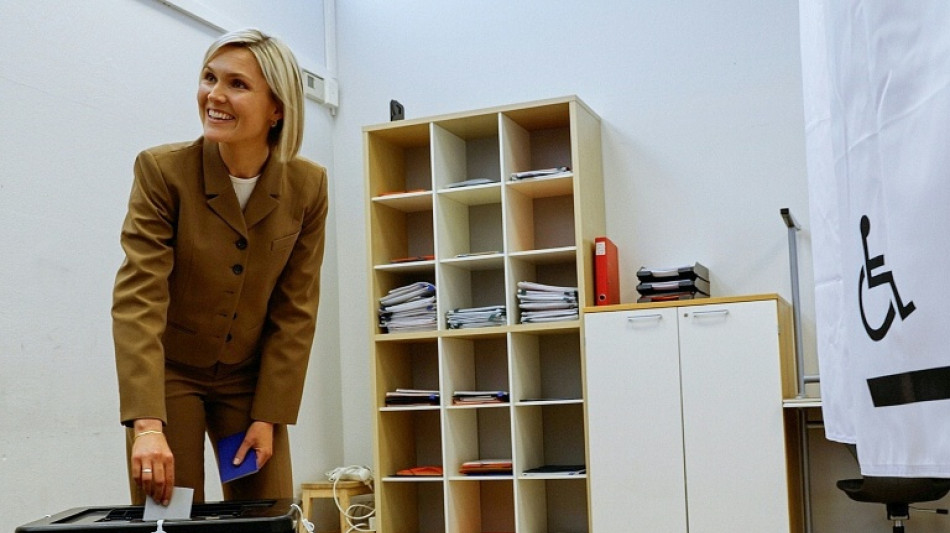
The campaign had "lifted discussions about the EU, about Iceland's place in the world, about our general geopolitical situation and status, to a higher level", Frostadottir said on Saturday after she cast her ballot.
She was openly in favour of a 'Yes', but "we will be fine also if it's a 'No'," she said.
Frostadottir had vowed that if Iceland rejected the resumption of entry talks, the EU membership issue would not be put back on the political agenda during her mandate, which ends in 2028.
The government had also said that in the event of a 'No', it would leave to parliament the question of whether or not to formally withdraw the country's EU membership application.
Political analysts had said they did not expect the government to resign if the 'No' side won. Made up of three parties with differing views on EU membership, it could emerge weakened by a rejection.
Had the 'Yes' camp emerged victorious, Iceland would have resumed its negotiations with Brussels, including on the hotly contested issue of fishing -- a pillar of Iceland's economy and part of its national identity, and over which Reykjavik wants to retain exclusive control.
Any accession agreement would have then been put to a new referendum in Iceland.
The fisheries sector has been fiercely opposed to joining the bloc -- 90 percent of companies in the industry are against the idea -- and the EU had tried to woo them with a conciliatory approach ahead of the vote.
"Iceland's unique specificities on fisheries and agriculture are well known. They would have to be carefully considered," EU Enlargement Commissioner Marta Kos had said.
"I'm confident that, together with EU member states, we would find creative solutions."
An EU source in Brussels told AFP: "I don't think anyone (in the EU) wants to block an accession over a question of fish."
It would also have enabled it to enlarge its presence in the strategic Arctic region, and perhaps helped change some minds in ultra-wealthy non-EU member Norway.
J.Jaspers--LCdB