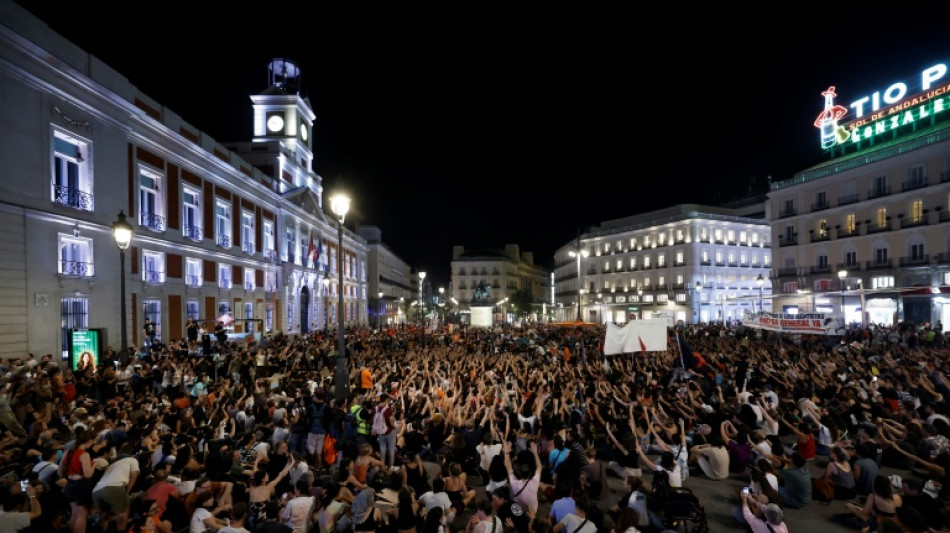
Housing protesters camp in central Madrid after mass demonstration / Photo: Oscar DEL POZO - AFP
Tens of thousands of people marched through Madrid on Saturday to protest the eviction earlier this week of an 87-year-old woman from her lifelong home, calling for greater protection for tenants.
Images of Maricarmen Abascal being carried from her Madrid flat on a stretcher on Wednesday after police broke down her door have thrust Spain's housing crisis back into the spotlight ahead of a general election due in 2027.
Thousands of people marched through the streets of Madrid rattling keys and blowing whistles to call for measures to curb rising housing costs and make evictions more difficult.
"You could be the next Maricarmen," read one banner on display at the rally.
Government authorities put the turnout at around 25,000, while the Madrid Tenants' Union, which organised the protest, said over 300,000 had taken part.
After the rally wrapped up, some activists set up a protest camp in city centre's Plaze de Sol square, the union said in a statement, urging people to gather there.
"We can't take it any more," it added in a post on X. "Either the rental system falls, or the government falls."
Police looked on as about a dozen tents were set up in the square in front of the headquarters of the Madrid regional government, surrounded by thousands of protesters, according to an AFP reporter at the scene.
- 'Live in fear' -
Abascal was forced to leave the apartment where she had lived for 70 years after a real estate firm acquired the property and raised the rent by 275 percent to 2,650 euros ($3,000), according to the union.
Now a symbol of Spain's housing crisis, had urged Spaniards to join the protest in a video message posted online just hours before it got underway.
"I want what has happened to me to serve so that it does not happen to other people," she said from hospital, where she has been treated for exhaustion since her eviction.
"I want it to encourage people to fight and to help change the laws that have allowed me to be evicted," she added in the video, posted by the tenants' union.
Protester Enrique Ortega de Miguel, a 38-year-old graphic designer who lives with his mother, said the housing market in Spain was "impossible".
"It is a struggle to find a place you can afford, then you live in fear of being forced out," he told AFP at the march earlier on Saturday.
Another protester, 33-year-old engineer Irene Lopez, told AFP the situation had become "unsustainable".
"There are people who can't afford to live in cities, rents are out of step with salaries," she said, describing the eviction of Maricarmen as "the last straw".
And Maricarmen Arnedo, a 76-year-old pensioner, said that while older people were being forced out of their homes, "young people can't move out of their parents' homes".
"We want house prices and rents to come down, because I'm fed up with washing the underpants of my 53-year-old son," she added.
- 'Fed up' -
Socialist Prime Minister Pedro Sanchez has faced regular protests across Spain over housing since Abascal's eviction.
The government is expected to approve a package of measures dubbed the "Maricarmen decree" at its next cabinet meeting, which would include the automatic renewal of rental contracts and further restrictions on evictions.
But it is unclear whether the package will be approved by parliament, where Sanchez's government lacks a majority.
While a similar bill was defeated earlier this year, Abascal's case has increased pressure on political parties to act.
Spain has little public housing, while rents have been driven up by increased demand, including from tourism and population growth linked to immigration, analysts say.
X.Thijs--LCdB