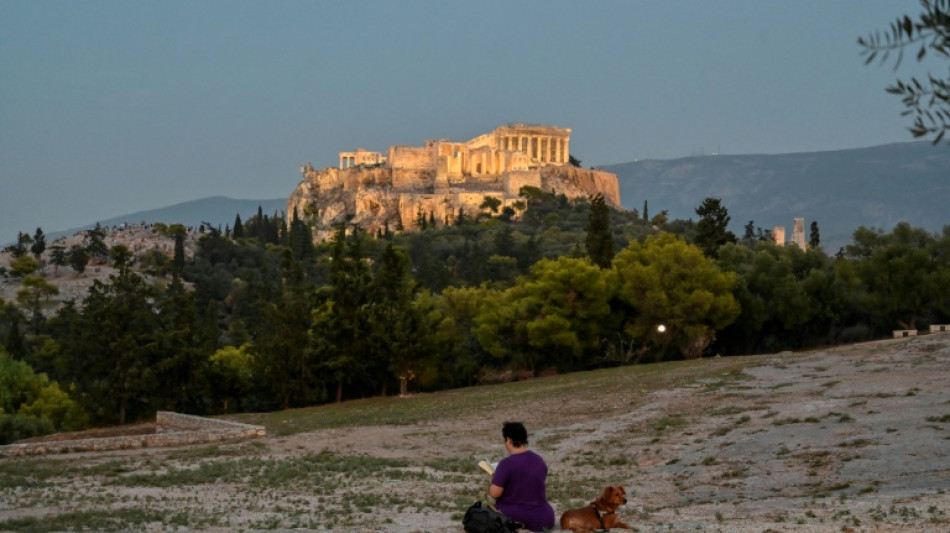
West must embrace 'national power' or face decline: Rubio / Photo: Louisa GOULIAMAKI - AFP
The western world must embrace "national power" and technological innovation or risk sliding into decline, US Secretary of State Marco Rubio was set to warn on Wednesday during a visit to Greece.
His speech, which will be packed with praise for ancient heroes such as Alexander the Great, follows an address in February where he argued that Europe was threatened by mass immigration and called for it to defend Christian civilisation.
This time he will say the West is "at a crossroads" that will determine whether it "maintains its place at the head of the world, or resigns itself to a future of atrophy, servitude, and decline".
"Either we choose to act now, or lose the choice to act at all," he was set to say, according to excerpts from a speech he is to deliver later near the Acropolis.
The US under President Donald Trump has made its choice, according to Rubio.
"We choose the unapologetic pursuit of national power: to take back control of our critical supply chains, to reindustrialise our economy, to rebuild our defence, to fight for dominance of the technologies and industries of the future," he is to say.
- 'Critical' alliance -
Rubio will speak from the ancient site of the Pnyx, the hill facing the Acropolis in Athens and the birthplace of Western democracy.
Earlier on Wednesday, Rubio, who arrived in Greece the previous day from Iceland as part of a European tour, underlined the "critical" US alliance with Greece.
He flagged in particular the energy sector, and announced a joint agreement on information-sharing on drug trafficking and terrorism.
"As you see a world that faces... destabilising events, you recognise how important this alliance with Greece is to the United States," he said, referencing the conflicts in the Middle East and between Ukraine and Russia.
Regarding Iran, he argued that Tehran had "lost complete control" of the Strait of Hormuz, seeking to offer reassurance at a time when the US is struggling to find a way out of the war just weeks before the midterm elections.
Rubio took part Wednesday in a "strategic dialogue" with Greece on regional and energy security amid high tensions triggered by the wars in Iran and Ukraine.
He is scheduled to meet conservative Prime Minister Kyriakos Mitsotakis on Wednesday evening.
– US envoy controversy –
The wars in Iran and Ukraine have highlighted the fragility of energy supply routes, and Greece is positioning itself as a key hub in southeastern Europe, particularly for the transport of natural gas.
Recently opened gas pipelines and port infrastructure have enabled Greece to contribute to the vertical corridor through eastern Europe to Ukraine.
Rubio's visit to Greece comes as the American press has in recent days reported on possible conflicts of interest involving the US ambassador to Greece, Kimberly Guilfoyle.
Several Democrats have accused Guilfoyle -- a former fiancee of US President Donald Trump's son, Donald Jr -- of promoting the commercial interests of a Greek construction and energy company during official diplomatic engagements.
Asked about this, Rubio refused to answer, but reiterated his support for the former Fox News presenter.
J.Jaspers--LCdB