India detains top 'cockroach' leader as hundreds protest in capital / Photo: Arun SANKAR - AFP
Indian police detained Cockroach Janta Party (CJP) leader Abhijeet Dipke on Friday ahead of fresh protests demanding the removal of the country's election chief, the youth-led movement said in a social media post.
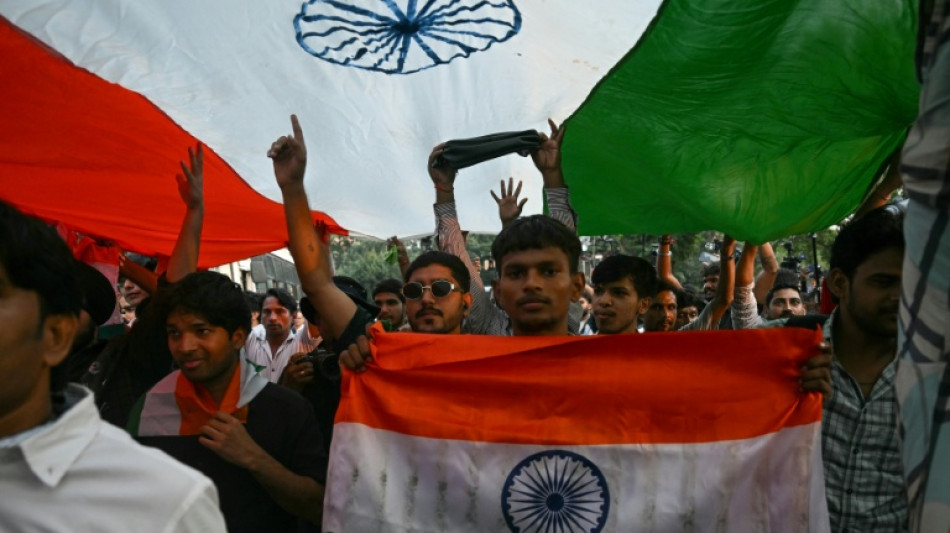
Dipke, 31, was detained shortly before a rally called by the online movement in the heart of New Delhi where hundreds of protesters marched on Friday evening, despite heavy security measures.
The CJP founder had urged supporters to gather in the capital's busy commercial hub of Connaught Place with Indian flags in a show of solidarity after two of his colleagues were detained this week for breaching security barricades at Jantar Mantar, a protest site declared off-limits by police.
"Abhijeet is detained by Delhi Police!!! This government is so scared of the youth waving national flag!!," the CJP said on social media, with footage of his detention also broadcast live on local television channels.
Police did not immediately respond to AFP's request for comment on the grounds for Dipke's detention.
The CJP, as well as opposition parties, have been seeking the resignation of India's chief election commissioner over a large-scale voter roll revision that they say favours Prime Minister Narendra Modi's ruling party.
The Election Commission of India, which oversees voting in the world's most populous nation, has denied any wrongdoing.
Thousands of security personnel were deployed in central Delhi on Friday, with police warning protesters to stay away, citing orders restricting public gatherings.
But hundreds of young protesters defied the crackdown to march close to Connaught Place's Central Park, many of them waving flags in a show of defiance.
Student activist Neha Bora was also detained and taken away in a bus by police as she was leading a march close to Central Park on Friday, AFP journalists witnessed.
Vishwajeet Pratap Singh, 18, said he had come to voice his protest against what he saw as a "targeted drive" to remove citizens from the electoral rolls who were not likely to vote for Modi's ruling Bharatiya Janata Party (BJP).
"If I don't speak today, no one will speak for me later," he told AFP.
- 'Creating anarchy' -
In the past week, the Indian capital has seen several street protests against the electoral roll revision, overseen by Chief Election Commissioner Gyanesh Kumar.
Critics say the removals have disproportionately affected minorities, particularly Muslims.
Members of BJP have long alleged that large numbers of undocumented Muslim migrants from neighbouring Bangladesh have fraudulently entered India's electoral rolls.
Election authorities say the move was intended to eliminate duplicate, deceased and fraudulent entries.
On Friday, Defence Minister Rajnath Singh dismissed the accusations, saying the agenda of opposition parties was "to destroy democratic institutions and create unrest in the country".
"Their fight is not for electoral reform... not for Gyanesh Kumar, not for the bright future of the country's youth," he said at a news conference.
"Rather, this is their conspiracy to seize power by creating anarchy in the country."
The "cockroach" movement has gained millions of followers on social media since it was launched by Dipke in May.
Protests organised by the CJP in July over exam irregularities forced the resignation of the education minister, marking a rare climbdown by Modi's administration.
Political commentator Ajoy Bose said the government was caught between a "rock and hard place" while seeking to prevent a repeat of the massive CJP protests in July.
"There's a general public perception that the elections have been compromised," he told AFP.
"Then there is a huge, restless, educated middle class, which are the new have-nots, in the sense that they don't see much future. So, I think the government is very worried about that section turning against them."
R.Michiels--LCdB