Ukraine's young figure skaters twizzle on despite Russian threat / Photo: Genya SAVILOV - AFP
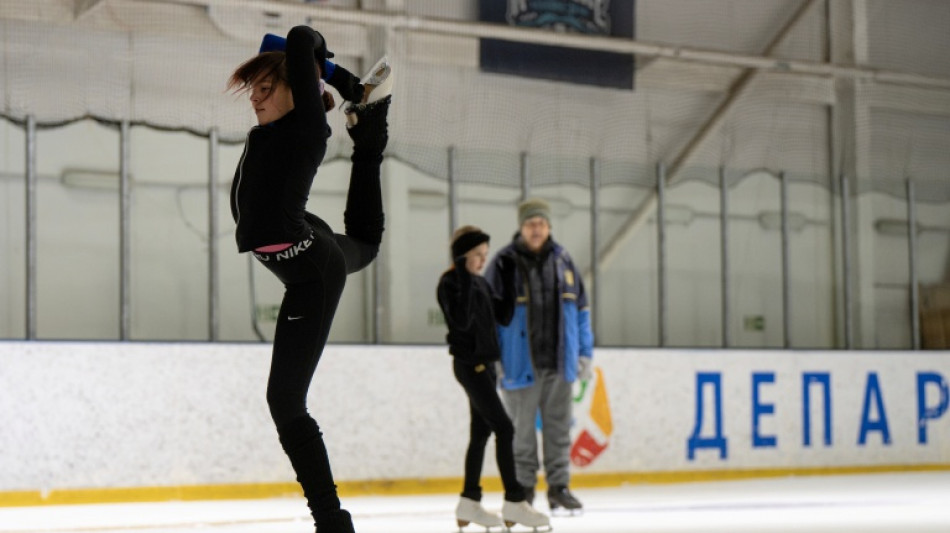
When music suddenly stopped at a Kyiv ice rink and a siren blared out announcing a drone threat, Ukraine's top young skaters didn't miss a beat, and carried on perfecting jumps and honing twizzles.
Two days later, a Russian overnight strike ripped open the venue, leaving a gaping hole in the wall but no casualties.
Between sleepless nights and incessant air raid sirens, the future Olympic hopefuls have long had to compete not just with their peers but against wartime odds.
But Yulia Ratnykova, mother of 11-year-old skater Katya, said even with the severe damage to the rink, they were undeterred.
"Naturally, the girls were very upset -- there were even tears," Ratnykova told AFP, adding defiantly: "No one is quitting, training will go on."
Just days before the blast, AFP visited the arena to speak to young athletes, their parents and trainers for whom the measure of good results has been transformed since Russia invaded in 2022.
"Every time you head out to a competition in the morning and see all the children, you know the night has gone well," trainer Oleksandr Tumanovsky said.
"If they're alive, that's already a success."
- Loud music -
Tumanovsky, a former leading Soviet skater, now wears a jacket emblazoned with Ukraine's national symbol and keeps a watchful eye on his group of three girls aged nine to 11 practising to rhythmic music.
At 6:15 am, just over an hour after the end of the overnight curfew, the ice was brimming with a few dozen other children, from toddlers to adolescents, mastering steps, jumps and twirls.
With Kyiv on near-constant alert against Russian strikes, halting workouts with every siren has proved impossible, Tumanovsky said.
At first, the children would run to shelter in a school nearby -- but that turned to a "track-and-field" workout instead, Tumanovsky smirked.
With the parents' blessing, training continued despite the alerts. But one thing has changed.
"When the blasts get too loud, we turn the music up -- so the children don't get scared," Tumanovsky said.
- Improvised beds -
Yulia Yermolayeva, 42, and her daughter Myroslava moved to Kyiv after fleeing Kharkiv near the Russian border when Moscow invaded.
Myroslava now trains six hours a day, six days a week under Tumanovsky but sleep is a constant battle.
"There are days when it's incredibly hard," her mother said.
At times she has to wake her daughter up and move to a shelter. On more dangerous nights, they sleep in the car in an underground car park, wake up "and head straight to training".
Myroslava also sometimes sleeps in the hallway on an improvised bed of pillows, blankets and duvets.
"It's obviously not as soft as a regular bed, but it's fine," she said with a shy smile.
Yulia Ratnykova has a similar arrangement for her daughter Katya, who sleeps on a camping mat and inflatable mattress.
"To be honest, I don't even remember when she last slept in her own bed," she said.
Each morning, the parents have to weigh up the risks to decide whether to let the girls go skating.
"It's a bit like being in a forest full of dangers: you have to stay constantly alert to avoid them," Ratnykova said.
The ordeal takes a toll on the children and their performance, Yermolayeva acknowledged.
"Compared to other children training in better conditions in Europe, we aren't really competitive -- she simply can't give 100 percent."
- 'Truly terrifying' -
Air alerts are also a permanent fixture at competitions in Ukraine.
"The children have to leave and sit in a shelter for two hours. By the time they come back out, they're in no state to compete: the right mindset is completely gone," Yermolayeva said.
Competing abroad has also been hampered by the closure of Ukrainian airspace.
"The journey now takes 24 hours instead of three... The longer the trip, the higher the risk that things won't go as well as they should," Tumanovsky said.
After the attack that damaged the rink, the Ukrainian Figure Skating Federation wrote in protest to the International Skating Union (ISU).
"Ukrainian skaters are being deprived of the most basic conditions necessary to train, compete, and pursue their lives as athletes," it read.
As his group trained, Tumanovsky said it was "truly terrifying" that children were getting used to the sound of explosions.
"Children should be getting used to completely different kinds of sounds, like the rustling of leaves or the wind blowing but not the sounds made by those scumbags," he added.
Work began almost instantly to repair the rink.
"Walls can be rebuilt, and I'm hopeful that by next week we'll be back on the ice," said Tumanovsky. "We're Ukrainians, after all."
P.Matthys--LCdB