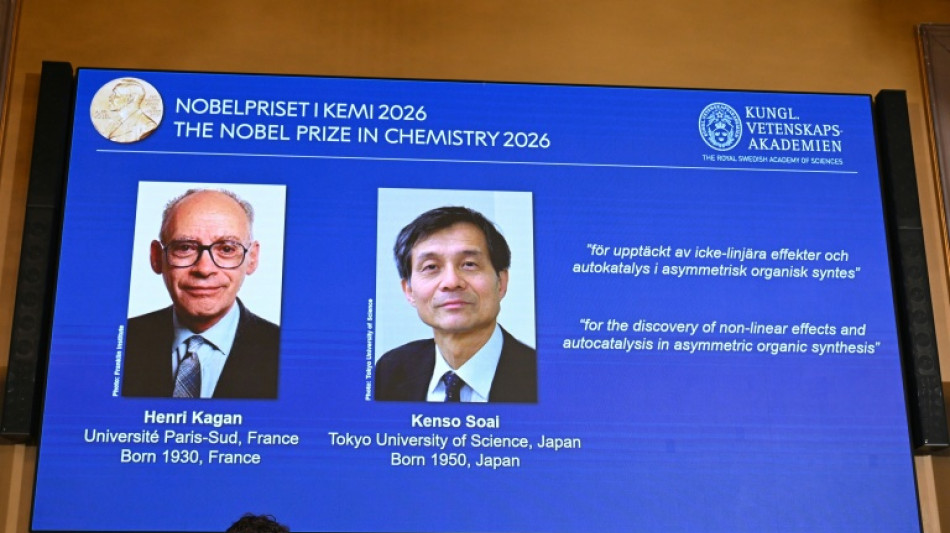
French-Japanese duo wins chemistry Nobel for solving molecular 'mystery' / Photo: Jonathan Nackstrand - AFP
France's Henri Kagan and Japan's Kenso Soai on Wednesday won the Nobel Prize in Chemistry for solving the mystery of why only one form of certain molecules appears in nature, a discovery decisive for the manufacture of pharmaceuticals.
The pair were honoured "for the discovery of non-linear effects and autocatalysis in asymmetric organic synthesis", the jury said.
Like hands, molecules such as amino acids exist as two mirrored variants, but only one of them is found in the proteins in the body's cells.
The other is rarely found in nature, a phenomenon known as "homochirality", the Royal Swedish Academy of Sciences explained.
"Henri Kagan and Kenso Soai have provided a solution to a chemical mystery that is over a century old: how homochirality can emerge spontaneously," Heiner Linke, chair of the Nobel Committee for Chemistry, told a press conference.
"The chemical reactions they have developed are spectacular," Linke added.
Kagan, 95, is professor emeritus at the Universite Paris-Saclay in France while Soai, 76, is a professor at Tokyo University of Science.
Soai, who was out shopping when he received the call from Stockholm, said it was one of "the most exciting days in my life", when reached by the Nobel Foundation during Wednesday's press conference announcing the laureates.
- Mirrored keys -
The academy said in a separate statement that the "molecules of life make things difficult for chemists".
It likened the problem to a locksmith creating keys to order but whenever they produce them they get two mirrored variants.
"Only one of them fits the lock -- and the lock can be damaged if your customers try to unlock it with the other key."
One example of the potential danger of using the wrong key, or version, was the thalidomide scandal in the early 1960s, when thousands of children were affected by birth defects.
"When researchers analysed what had happened, they realised that it was the active substance's mirror image that caused the harm," the academy said.
Through the work Kagan and Soai did in the 1980s and 1990s, chemists were able to understand how chemical reactions could be controlled to produce one side of the mirror image.
"Thanks to Henri Kagan and Kenso Soai, we now know how homochirality can emerge," the jury said.
"Their discoveries have been decisive for chemists who design reactions for the manufacture of pharmaceuticals."
- Snubbed -
Kagan had previously missed out on the Nobel prize.
In 2001, the chemistry prize was awarded to William Knowles, Ryoji Noyori and Barry Sharpless for their pioneering work in asymmetric catalysis.
That sparked controversy, with many French chemists outraged by the absence of the man regarded internationally as the "father" of the technique.
Last year, the chemistry prize went to Japan's Susumu Kitagawa, UK-born Richard Robson and American-Jordanian Omar Yaghi for developing a method of designing molecular structures.
The chemistry prize follows the physics prize, which on Tuesday honoured Belgian physicist Francis Halzen for groundbreaking work using Antarctic ice to capture particles originating in the distant cosmos.
On Monday, the medicine prize was awarded to US psychiatrist and neurologist Karl Deisseroth and German scientists Peter Hegemann and Georg Nagel.
The literature laureate will be revealed on Thursday, and perhaps the most keenly anticipated award -- the peace prize -- is due on Friday.
US President Donald Trump lobbied intensively last year to get the prize -- Venezuelan opposition leader Maria Corina Machado ended up giving him her Nobel medal -- and the committee is aware he will be watching closely again.
The economics prize wraps up the Nobel season on October 12.
The Nobel award consists of a diploma, a gold medal and a 12-million-kronor ($1.2-million) prize sum, which is shared if there is more than one winner in a discipline.
The laureates will receive their prizes at a formal ceremony on December 10, the anniversary of the death in 1896 of scientist Alfred Nobel, who created the prizes in his will.
E.Celis--LCdB