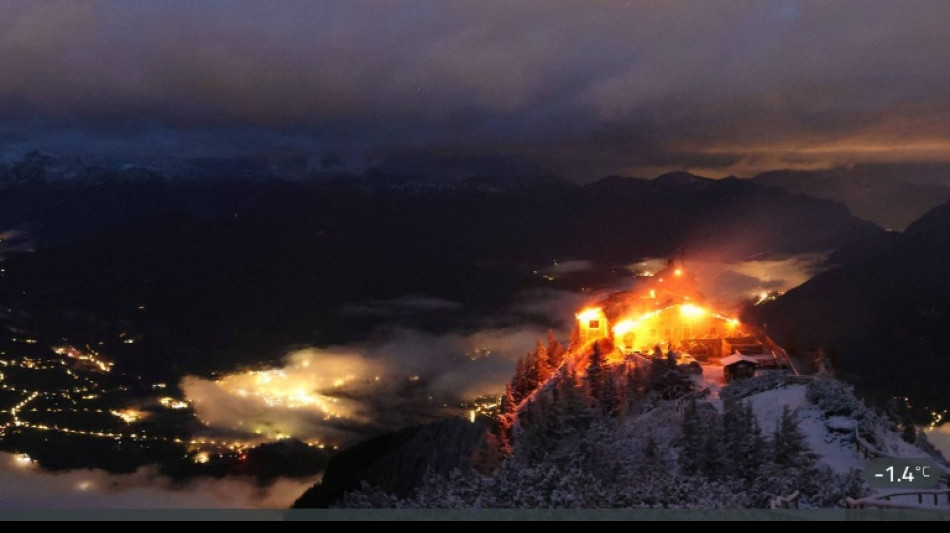
Suspect detained after fire wrecks Hitler's mountain retreat / Photo: - - AFP
Firefighters battled on Saturday to put out flames that tore through Adolf Hitler's "Eagle's Nest" mountain retreat while police detained a suspect who investigators said may have psychiatric problems.
The alarm was raised late on Friday at the former guest house for top Nazi officials, 1,834 metres (6,000 feet) high in the Bavarian Alps.
As snow fell on the Alpine peak, the Eagle's Nest was still engulfed in flames at dawn on Saturday and fire chief Michael Brandl told a press conference the last elements of the inferno were being put out during the afternoon.
No-one has entered the building because of fears it could collapse, Brandl added.
"We are very lucky that there are no injuries," Brandl said.
Some 200 firefighters were mobilised for the operation at the Kehlsteinhaus residence on a summit above Obersalzberg in southern Germany that draws some 350,000 visitors a year, according to Bavarian state authorities.
Authorities said access had been difficult after the fire alarm went off at 9:50 pm (1950 GMT).
Heavy rain was followed by a snow storm and then violent winds hit the mountains.
Police spokeswoman Lisa Maier said the firefighters had needed breathing apparatus to get near.
Firefighters saw flames rising high into the air as they approached the scene, only to find the building "completely ablaze", police said.
Bavarian state interior minister Joachim Herrmann said the fire appeared to be "a malicious act" and police said that a suspect was detained at the scene.
Firefighters and police heading to the Eagle's Nest saw "a rider on a red motorcycle with no licence plate" and stopped him, Robert Holzinger, a Bavarian police official, told a press conference.
The suspect is a 33-year-old German who has ties to the area but does not live there, Rainer Vietze, a public prosecutor's spokesperson, was quoted as saying by the local PNP newspaper.
Possible political motives were being examined but investigators believed there was a "potential mental illness", the spokesperson added.
- Monument to Hitler -
Police blocked access to the retreat on Saturday.
Built between 1937 and 1938, the Eagle's Nest forms part of the toxic legacy of Hitler's Third Reich, which was responsible for the deaths of millions of Jews, Roma, LGBTQ people and Communists during the Holocaust.
It was designed to serve as a monument to Hitler's rule, although the dictator himself seldom visited the complex that was heavily guarded. Hitler had another country residence nearby at Berghof.
Built of stone and granite, the Eagle's Nest offers an exceptional view of the Alpine landscape and was designed to impress foreign diplomats. Hitler used it as a backdrop for his propaganda movies.
It survived the Second World War undamaged and later gained notoriety through post-war Hollywood films that recreated the residence.
Since 1952, it has hosted both an exhibition recounting the house's Nazi history and a restaurant.
The website says the Eagle's Nest "stands for the insanity of the regime and the world on the Obersalzberg, where plans for war and mass murder were formed".
"This house -- the entire site and its surroundings -- is linked to a specific history. It is important that we continue our work of remembrance," Herrmann said.
M.Franck--LCdB