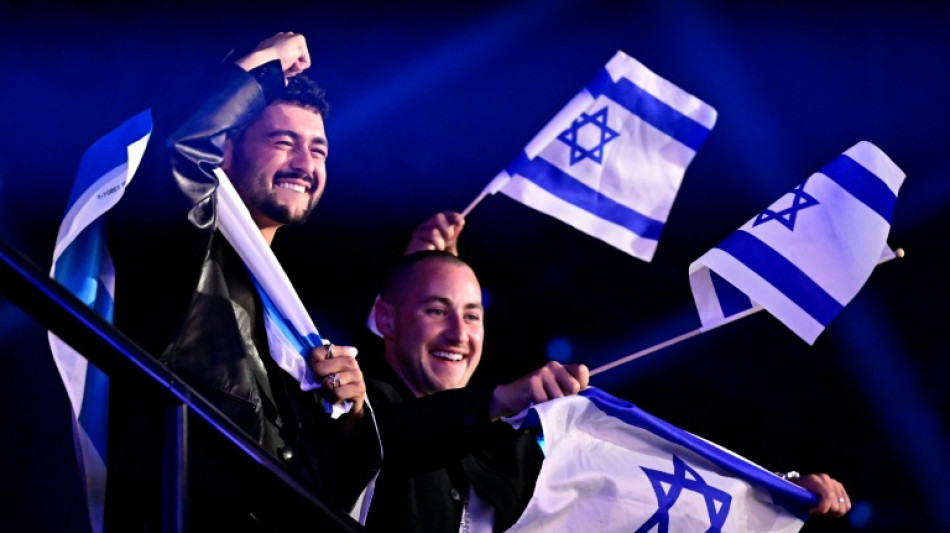
Four ejected from Eurovision after Israel song disruption / Photo: Tobias SCHWARZ - AFP
Four people were thrown out of the first Eurovision Song Contest semi-final, which saw attempts to disrupt Israel's performance, organisers said Wednesday.
As 28-year-old Israeli singer Noam Bettan began his performance of "Michelle" during Tuesday's live show, a protester could be heard shouting "Stop, stop the genocide", and "Free, free Palestine".
Israel's participation in Eurovision 2026 has caused Spain, the Netherlands, Ireland, Iceland and Slovenia to pull out of the world's biggest live televised music event.
Eurovision is run by the European Broadcasting Union, the world's biggest alliance of public-service media.
In a joint statement, Austrian host broadcaster ORF and the EBU said: "An audience of 10,000 fans in the Wiener Stadthalle at the first semi-final of the 70th Eurovision Song Contest in Vienna greeted every artist enthusiastically.
"ORF is broadcasting a clean audio feed live from audience microphones before and during every performer's song.
"One audience member, close to a microphone, loudly expressed their views as the Israeli artist began his performance, and during the song, which was heard on the live broadcast. They were later removed by security for continuing to disturb the audience.
"Three other people were also removed from the arena by security for disruptive behaviour."
Bettan told BBC television on Wednesday he was "aware" of what was happening in the audience.
"I heard there was booing and everything, and there was a moment of, like, a wow effect, you know? A little bit of shock," he said.
- Five countries boycotting -
This year's 70th edition of Eurovision is facing its biggest-ever political boycott.
Besides unease at the conduct of Israel's war with Hamas in the Gaza Strip, some broadcasters raised concerns about media freedom, with Israel preventing their journalists from accessing Gaza.
They also raised concerns that the televoting system was being manipulated to boost Israel last year.
Israel comfortably topped the public voting in Basel at Eurovision 2025, and in the semi-finals scored maximum points in 13 out of 19 country votes.
In September, Dutch public broadcaster AVROTROS said there was "evidence of interference by the Israeli government during the most recent edition".
In November, the EBU changed the voting system, with Eurovision director Martin Green saying: "We've listened and we've acted."
Under the new rules aimed at assuaging broadcasters' concerns, the maximum number of votes per payment method was halved from 20 to 10.
The EBU announced an expansion of the contest's security systems, which "detect and prevent fraudulent or coordinated voting activity, and strengthen monitoring of suspicious patterns".
The new rules discourage "disproportionate promotion campaigns", particularly those done or backed by third parties, including governments and state agencies.
"Participating broadcasters and artists are not permitted to actively engage in, facilitate or contribute to promotional campaigns by third parties that could influence the voting outcome," the EBU said at the time.
On Saturday, Green said a formal warning had been issued to Israeli public broadcaster KAN on Friday after Bettan released videos "with an on-screen instruction to 'vote 10 times for Israel'."
This was "not in line with our rules nor the spirit of the competition", Green said, adding that the videos were swiftly removed.
Fifteen countries were competing in the first semi, with Israel among the 10 who progressed to Saturday's final.
F.Claes--LCdB