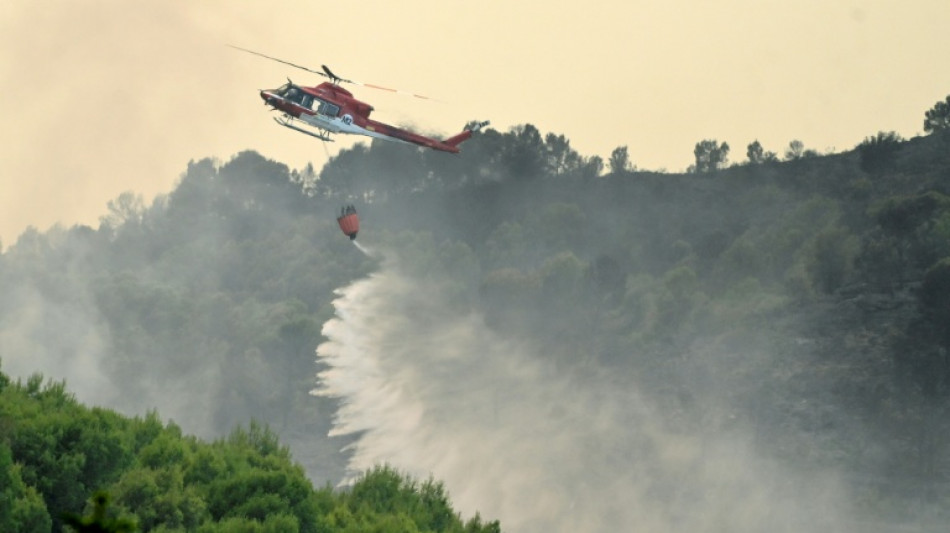
'Monster' wildfires force 350,000 from homes in France, Spain / Photo: Jose JORDAN - AFP
Forests burned and villages emptied as more than 325,000 people fled blazes tearing through France and Spain on Sunday, with firefighters struggling to contain flames stretching kilometres.
Forests burned and villages emptied as more than 325,000 people fled blazes tearing through France and Spain on Sunday, with giant smoke plumes the sky and firefighters struggling to contain the flames.
The forest infernos, raging for days in France's southwest and central Spain near Madrid, rank among the worst either nation has seen in peacetime.
France's major fire has caused an unprecedented "pyrocumulonimbus" -- a gigantic fire cloud that creates its own winds and packs lightning that causes more blazes, said the National Firefighters Federation of France (FNSPF).
"It's a David-versus-Goliath scenario... at some point, we'll find a weak spot and strike there," said FNSPF spokesman Eric Brocardi.
French President Emmanuel Macron has called a Monday morning crisis cabinet meeting to discuss the emergency, his office said.
Spain's Interior Minister Fernando Grande-Marlaska said Sunday evening the fires were advancing, but slowly.
But firefighters there were battling a new blaze Sunday near the eastern coastal city of Valencia, where 15,000 people have been forced to flee their homes.
"Difficult hours lie ahead," Spanish Prime Minister Pedro Sanchez said as he visited the fire zone in Avila province west of Madrid Sunday. He is due to visit affected areas in Valencia on Monday.
Describing the fire around Avila, civil protection chief Virginia Barcones said the country was battling a "monster".
"We are dealing with a perimeter of 280 kilometres encompassing 77,000 hectares," Barcones told state broadcaster TVE of the wildfire.
Other EU countries have sent aircraft, crews and vehicles to help both countries.
- 'Extremely intense' -
Scientists say climate change is making such extreme weather events more frequent and intense.
Coming at the height of the summer holiday season, the fires were fuelled by woodland parched to tinder by successive heatwaves and lack of rain since May.
In France, the prefect of the southwestern Gironde region where the country's fires are concentrated urged tourists to stay away and seek "alternative destinations".
Garden hose in hand, Georges Clivaz sprayed water along a road leading to his property in Saint-Jean-d'Illac as the blaze burned a few kilometres away.
"We're doing this to slow down the fire's advance; we want to save our homes," he told AFP.
Although the village was evacuated on Friday, Clivaz said he and his family were trying to hold out.
"But the firefighters are telling us that in two or three hours the fire will be here."
Interior Minister Laurent Nunez warned "the situation remains very unfavourable" across France, where more than 250,000 people had been evacuated.
The main fire in Gironde, home to Bordeaux, was "extremely intense and unpredictable... generating its own winds and advancing erratically toward the Bordeaux metropolitan area", he said on X.
- Firefighters injured -
Since Wednesday the fire in the Gironde region has injured 75 firefighters, 10 of whom have been evacuated, according to the latest situation report published Sunday by the prefecture.
Sebastien Bouvier, leader of France's CFDT union, said firefighters did not have adequate equipment to protect themselves from the fires' toxic fumes.
Weather forecasters warn another heatwave could hit France from Tuesday, with temperatures reaching 40C in some areas.
At least 240 homes have been destroyed in Gironde region, many of them in village Le Porge.
But Bordeaux mayor Thomas Cazenave said there were no plans to evacuate the city's urban area, home to 850,000 people and sheltering thousands displaced by the fires. Local officials remained "vigilant", he added.
France's defence ministry said it has taken special steps to protect industrial sites around Bordeaux, a key centre of the country's aerospace industry.
The main freeway south of Bordeaux and rail services have been cut.
Some 2,500 firefighters, 1,500 military personnel and around 1,200 police have been deployed to the Gironde region.
- 'Incalculable' damage -
King Felipe VI, visiting an emergency shelter on Madrid's western outskirts, said the wildfires had caused "incalculable" damage to Spain's natural heritage.
Around 75,000 residents have been evacuated from the Madrid region, Avila, Toledo and from the eastern region of Castellon in Valencia.
Olga Congacha, 50, who fled her village of Robledo de Chavela west of Madrid carrying only documents and clothes, told AFP she felt "panicked" when told to leave her home.
"I didn't know whether to cry or what. It was a moment when you feel awful," she said.
Allowed a brief visit home Sunday to collect medicine, she found her house covered in ash and the streets deserted, she added.
Officials said winds were pushing wildfires near Madrid to the south, away from the capital for now, but forcing more evacuations of villages in their path.
Hundreds of kilometres away, the new Valencia fire was proving "very intense", Pilar Bernabe, the central government delegate to Valencia, wrote on X.
One person was killed on Saturday in a separate, smaller fire near Valencia, the only civilian death so far reported in the wildfires. In France, two firefighters were killed near Bordeaux on Tuesday.
Italy, too, was facing its own fires.
More than 400 tourists and beachgoers were evacuated by sea near the town of Peschici in the southern Puglia region, with 300 more expected to be rescued, said the coastguard.
burs-jj/rh
V.Renard--LCdB